You talk to one agent. It runs the rest.
ZeroAgent takes your request, picks the right Claude model for the job on your own subscription, writes the brief, and dispatches workers running Claude Code into their own git worktrees, checking on them until the work is actually finished. Free, local, on your own Mac.
or brew trust zeroagentdev/tap
brew install --cask zeroagentdev/tap/zeroagent
Homebrew 6 or newer needs that trust line before it will load the cask; older Homebrew can skip straight to installing.
macOS 14 or later, Apple Silicon or Intel. Requires Claude Code.
You talk to one agent, not to five.
Zero Agent reads the request, decides what it costs to do properly, writes the brief, and dispatches workers. It messages them mid flight, checks in on a timer that backs off when nothing changes, keeps watching anything that outlives the conversation like a CI run or a reply from another machine, and remembers what it learned about you between sessions. Workers land their own pull requests under your conventions. You get interrupted only when you actually have to decide something.
The canvas is the product
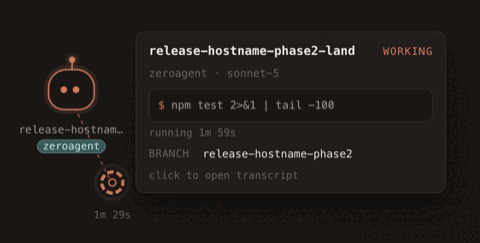
Workers are not rows in a table. They are creatures on a 2D canvas: colour and motion tell you what's happening without reading anything, so you can watch several agents at once without losing track of any of them, and a click opens the transcript.
What you get, free and local
Everything below costs nothing to run and needs no account. This is the whole app, not a trial.
It keeps checking so you do not have to
The lead sets itself reminders that fire on their own, tracks background work it can't watch like a CI run, and raises one task with one question when work goes quiet, instead of paging you for every worker that finishes.
Automatic model selection per dispatch
Routine work goes to a cheaper model, judgment calls go to a stronger one, chosen for each dispatch rather than a dropdown you have to remember to change.
Per worker cost tracking
Every worker carries its own bill: tokens in and out, running cost, right there on the canvas, so you know what a piece of work cost before you approve the next one.
It remembers what you told it, between sessions
A local, self-cleaning memory means a coding agent that remembers across sessions, so you don't re-explain your preferences and context every time you open the app.
Context tracking, with a handoff for long sessions
The app shows how full the lead's and each worker's context window is, live. When the lead fills up, it writes itself a handoff note and restarts clean, roster intact, so a long session never loses the thread.
It interrupts you only when you have to decide
A real macOS notification when work is blocked on you, a job finished long after you walked away, or a cost cap is about to be crossed, never for a routine completion. Click it to open that worker's transcript.
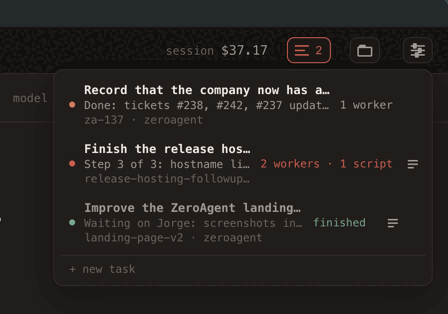
A task list grouped by what it serves
Workers are grouped under the piece of work they serve, with a title a person would actually use instead of an internal ticket id.
Read only agents for questions and surveys
Dispatch a worker that can look and report but can't write, for a question or a survey where you don't want anything in the repo to change.
Parallel workers, one git worktree each
Every dispatched worker gets its own git worktree and branch, cut and cleaned up automatically, so several things happening at once never collide. Its work lands as a pull request under your conventions before the worktree retires.
Your subscriptions, your keys
ZeroAgent never meters or marks up a model call. Today every worker runs on Claude models through your own Claude Code login, and the lead picks the right tier for the work automatically: Sonnet for routine work, Opus for the hard problems, Fable when a job needs to coordinate several workers, with no dropdown to remember. OpenAI models through Codex, and everything else through your own OpenRouter key, are on the way, so the same automatic pick reaches across providers, not just within Claude's own lineup.
Claude, via Claude Code
Your own subscription. Shipped today.
OpenAI, via Codex
Your own account. Coming.
Everything else, via OpenRouter
Your own key. Coming.
See it in the app
Six of the pieces above, as they actually look on the canvas.
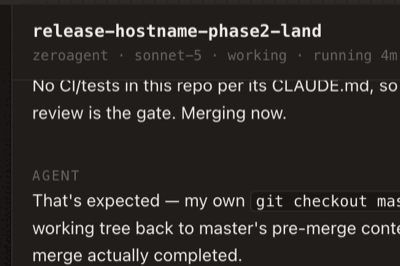
Model selection per dispatch
Named right in the worker's own panel, not hidden in a settings screen.
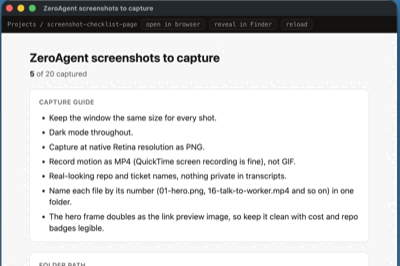
Artifacts, not just diffs
A chart, a page, a small app a worker built, opened right inside the app.
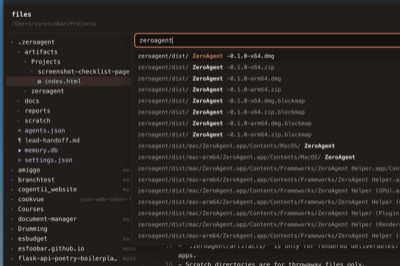
Fuzzy search, every repo
Find any file in any repo without leaving the app.
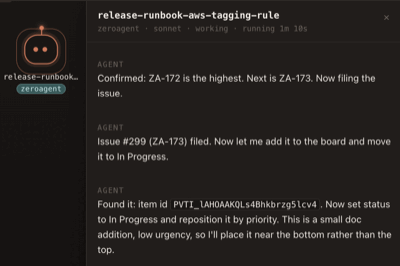
Talk to a running agent
Send a message mid flight instead of killing it and starting over.
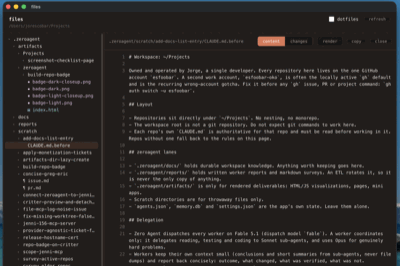
One workspace, many repositories
The same conversation reaches every repository in your projects folder.
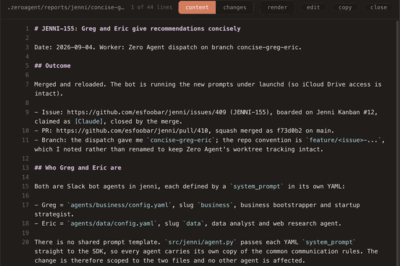
A report, not a wall of text
A worker's writeup renders as a formatted page, right where the work happened.
Watch your workers from your phone
ZeroAgent Premium pairs a native iOS companion with your Mac by scanning a QR code. It's a viewer and a nudger, not a second orchestrator: glance at the canvas, open a worker's transcript, answer a question it's waiting on, or send it a message from wherever you are. The work still runs on your own Mac; the phone only watches and steers it, with a push notification the moment a worker needs you.
Part of Premium, $5 a month, coming to the App Store.
Workers
How ZeroAgent orchestrates Claude Code
-
Point it at your projects folder
Set the root once in settings. ZeroAgent resolves it sensibly even if you don't, and the file explorer, memory and state all live under that one folder.
-
Describe the work in a sentence
Tell the lead agent orchestrator what you want in plain words. It writes the brief, decides what the work should cost, and dispatches a worker.
-
Workers open their own pull requests
A worker's job isn't done at "here's a diff." It follows your workspace conventions through tests, a pull request and a closed ticket, then its worktree is retired.
What ZeroAgent is not
- Not an IDE. Keep your editor.
- Not a terminal with more panes in it.
- Not five agents you have to babysit yourself.
- Not a kanban board.
- Not a cloud service. Your code never leaves your Mac.
Requirements
macOS 14 or later, Apple Silicon or Intel. Prerequisite: ZeroAgent coordinates the work; it drives a coding agent CLI already installed on your Mac to do it. Works with Claude Code today. Codex and other agents are planned.
Download ZeroAgent for Mac
Free, local, and yours to keep. Requires Claude Code.
Free for local work on your own Mac, with no account. Remote monitoring and the phone companion are Premium, $5 a month; cloud workspaces are coming later as Platinum.
Questions
How many coding agents can I run at once?
As many as your Mac and your model account can support. The default cap is eight worktrees at a time so a workspace doesn't fill the disk unnoticed; raise it in settings, and a dispatch past the cap is refused with a note on what to reclaim first.
Does ZeroAgent work with Claude Code?
Yes, today. ZeroAgent drives the Claude Code CLI already installed on your Mac. Codex and other agent runtimes are planned, not shipped yet.
Do I need an account or a subscription?
No. ZeroAgent runs entirely on your Mac with your own model keys, with nothing to sign in to and nothing that costs money today. Remote monitoring and the phone companion are Premium, $5 a month; cloud workspaces are coming later as Platinum.
How is this different from running git worktree by hand?
git worktree gives you the isolation. ZeroAgent is what decides when to cut one, keeps it separate from every other worker's, retires it safely once the work has landed, and sweeps up whatever a previous session left behind, automatically, across your whole projects folder rather than one repo at a time.
Does my code leave my Mac?
No. Your files, memory and settings live on disk on your machine. ZeroAgent talks to whichever model provider your coding agent CLI is already configured for, the same as if you ran that CLI yourself; nothing routes through a server we run.
Is ZeroAgent open source?
Not today. The app itself is closed source. That could change later, but there's no timeline for it yet.